

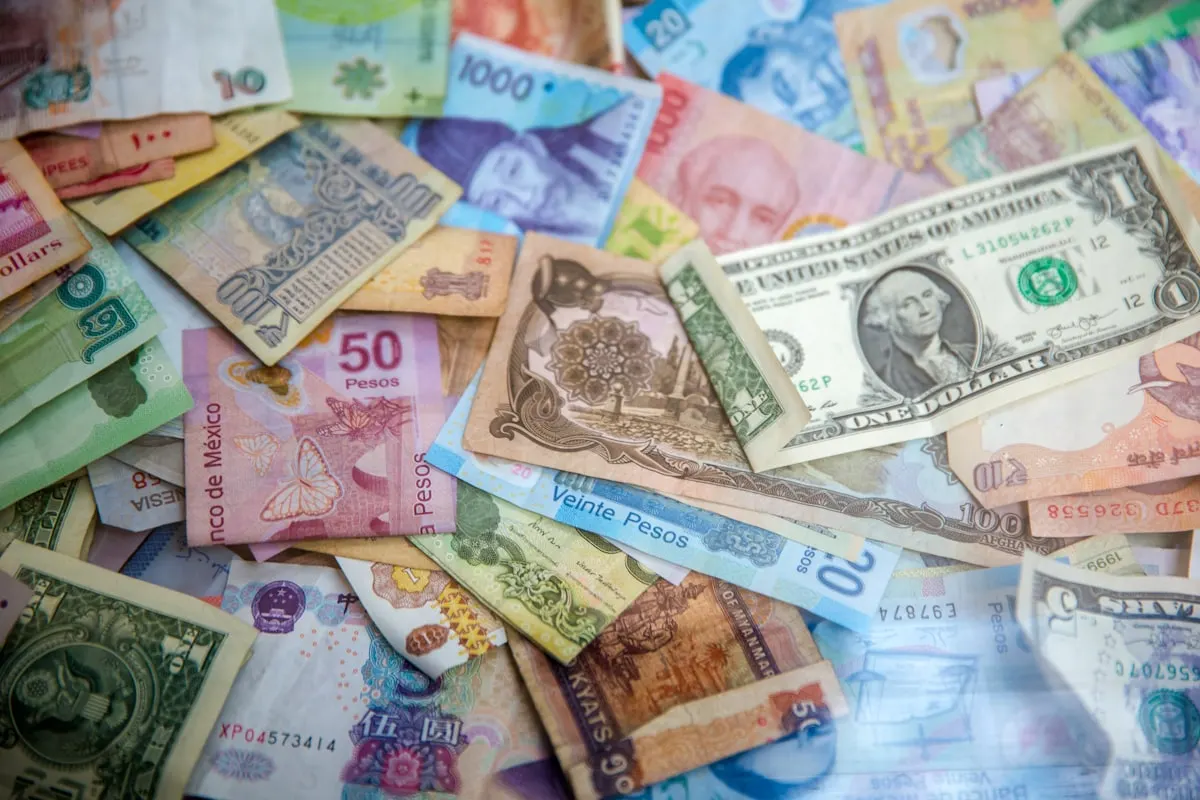
Forex (short for Foreign Exchange, or FX) is the global market where currencies are bought and sold. Every time you exchange euros for dollars on a trip, you are already taking part, on a small scale, in the currency market. In professional trading that same exchange happens electronically, in fractions of a second, with volumes exceeding 7 trillion dollars traded every day. That makes Forex the largest and most liquid financial market on the planet.
Unlike a stock exchange, Forex has no central physical headquarters. It is a decentralised market (OTC, over the counter) formed by a network of banks, institutions, brokers, and traders connected to one another. It operates 24 hours a day, five days a week, following the sun through the main sessions: Sydney, Tokyo, London, and New York. This continuity lets you react to news the moment it happens, without waiting for an opening bell.
Currencies are always traded in pairs, because when you buy one currency you are selling another at the same time. In the EUR/USD pair, for example, the euro is the base currency and the dollar is the quote currency. If the price is 1.0850, it means you need 1.0850 dollars to buy one euro. If you think the euro will strengthen against the dollar, you buy the pair (you go “long”); if you think it will weaken, you sell it (you go “short”).
Pairs fall into three categories. The majors always include the US dollar against other strong currencies —EUR/USD, GBP/USD, USD/JPY— and concentrate the highest liquidity and the tightest spreads. Crosses do not include the dollar, such as EUR/GBP or EUR/JPY. Exotics combine a strong currency with one from an emerging market, such as USD/MXN or USD/TRY; they offer more movement but also more risk and higher costs.
A pair’s quote is expressed with two prices: the bid (at which you can sell) and the ask (at which you can buy). The difference between them is called the spread, and it is one of the basic costs of trading. In the major pairs the spread is usually very small, while in exotics it is wider. Understanding the spread is essential, because every trade starts with a small loss equal to that differential.
What moves prices? At its core, the supply and demand for each currency. And behind them lie central bank interest rates, inflation, economic growth, political stability, and the risk appetite of global investors. A trader combines the analysis of these factors (fundamental analysis) with the study of charts (technical analysis) to decide when to enter and exit the market.
Forex is attractive because of its accessibility: you can start with modest capital thanks to leverage, trade at any hour, and access the markets from a platform like MetaTrader 5. But that same ease demands respect. Before risking real money, it is wise to practise on a demo account, learn to read a chart and, above all, understand risk management. At VexPro we believe an educated trader is a trader who lasts, and that is the purpose of this guide.
Sources: Bank for International Settlements (BIS), central banks, official MetaQuotes (MetaTrader 5) documentation and regulatory bodies.