

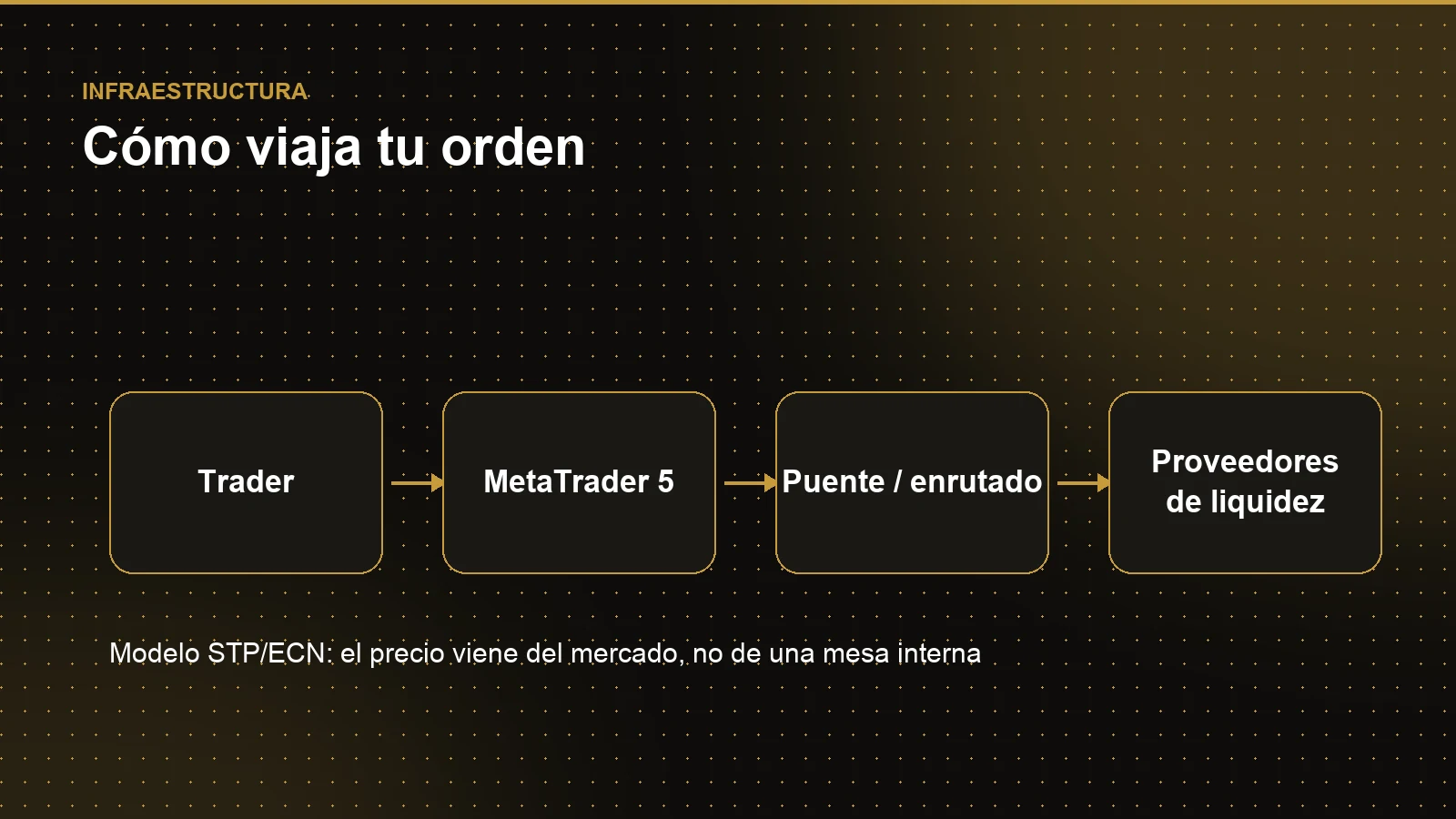
When you hit “buy” or “sell” on MetaTrader 5, several things happen within milliseconds. Understanding that journey is not a technical footnote: it explains where the price you see comes from, what you actually pay to trade and why execution sometimes does not match your expectations to the decimal.
VexPro operates an STP/ECN model. That means orders are routed to liquidity providers rather than the market being created internally: the broker does not manufacture its own prices or position itself as the counterparty to your trade. The price shown on the platform is the result of aggregating the quotes arriving from those sources, and the order is filled against the best one available at that moment.
In VexPro’s case, institutional liquidity comes from within the group itself: Exura Prime, an Investment Dealer regulated by the FSC of Mauritius, acts as the ecosystem’s liquidity provider. With provider and broker inside the same structure, the chain of intermediaries is shorter and the group keeps direct control over the quality of the quotes reaching the client.
The platform is MetaTrader 5, the industry standard. From it you can send market orders, limit orders and stop orders, set stop loss and take profit levels, and consult the depth of market to see the volume available at different price levels. Every trade is logged in the history with its execution price and exact time, so the whole journey can be reviewed afterwards.
Cost depends on the account type. On ECN accounts, spreads start from 0.0 pips and the cost is charged separately as a commission of $10 per lot on a round turn basis: the amount covers opening and closing the position, not each side separately. It is the usual structure for those trading volume who want to see the market price with the smallest possible mark-up.
On STP accounts there is no per-lot commission: the cost is built into the spread. Neither option is better in the abstract; the choice depends on style. Traders who place many orders a day at high volume usually find the ECN scheme more efficient, while those who trade less often, or prefer a single cost that is simple to calculate, tend to lean towards STP.
Speed is part of the equation too: average execution at VexPro is under 20 ms. Even so, no infrastructure eliminates slippage, the difference between the price requested and the price at which the order is finally filled. It exists because the market moves while the order travels and because, around news releases or session opens, the liquidity available at the best level thins out. It is managed, not removed: limit orders let you set a maximum acceptable price and avoid surprises during the most volatile stretches.
One last factor remains: leverage. It lets you control a position larger than your deposited balance, but it amplifies gains and losses equally and consumes margin. That is why risk management — position size matched to the account, a stop loss defined before entering and controlled exposure — is the part of the process that depends entirely on the trader. Trading the financial markets involves the possibility of losing the capital invested.
The essentials
STP/ECN model
Orders are routed to liquidity providers; the broker does not create the market internally.
Liquidity from the group
Exura Prime, an Investment Dealer regulated by the FSC of Mauritius, provides the institutional liquidity.
Transparent costs
ECN from 0.0 pips with a $10 per lot commission (round turn); STP with no commission, cost in the spread.
Average execution
Under 20 ms on average on MetaTrader 5; slippage is managed with limit orders.


Redacción VexPro
VexPro is the broker of VEX GROUP, a global financial and technology group present in 7 jurisdictions, and serves clients in more than 160 countries. Product news, expansion, events and regulation from the group.