

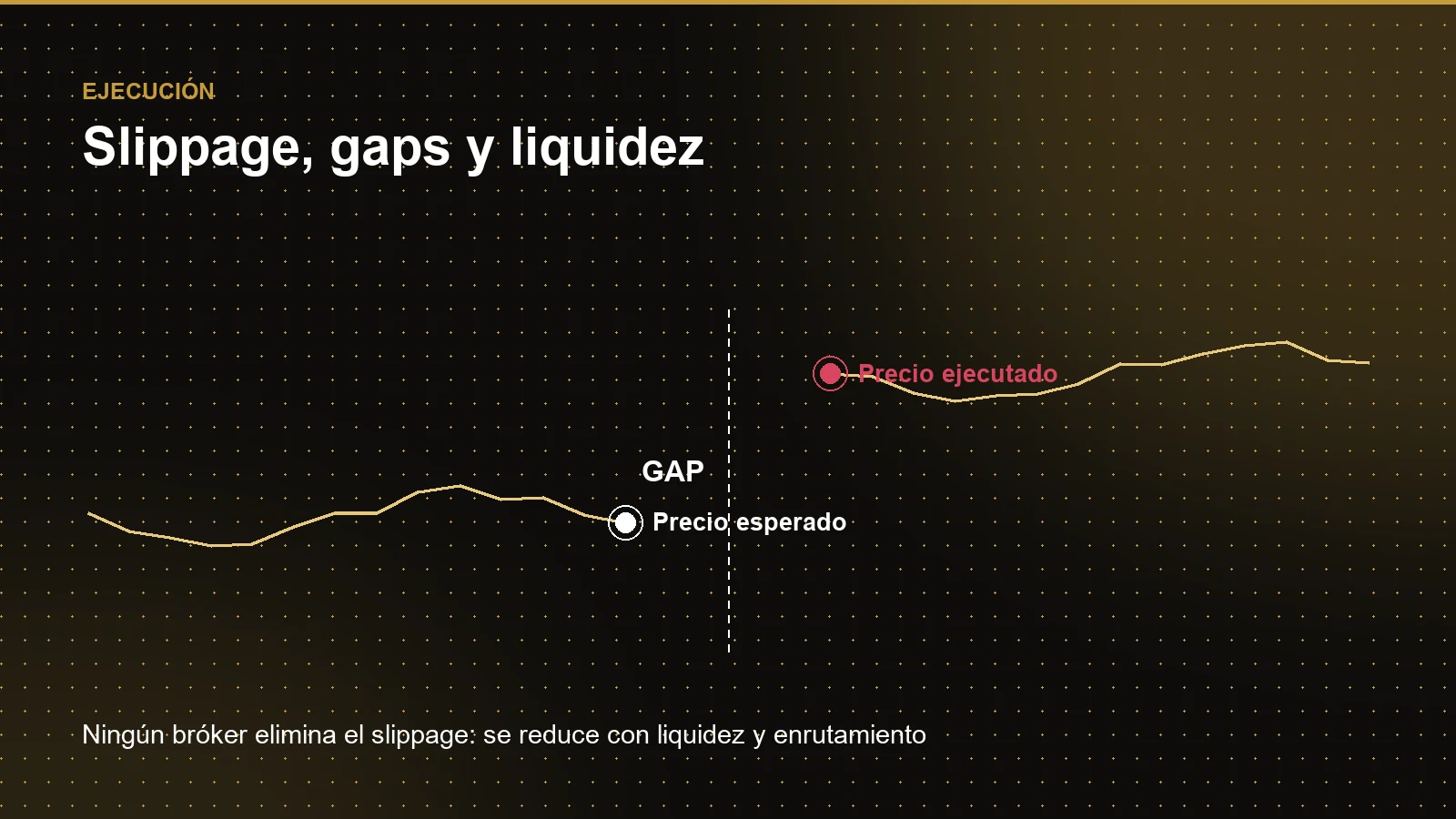
The price shown on the platform is the best quote available at one instant and for a given size. It is not a guaranteed price for any size or for any length of time: it is the visible tip of an order book that changes several times a second. Time passes between the click and the execution confirmation, and during that time the market keeps working.
The difference between the price requested and the price actually obtained is called slippage. It can be negative, when the fill arrives worse than requested, but also positive, when the price moves in your favour during that interval and the order fills better. A serious execution model applies both with the same rule; measuring the average slippage in your own history is more informative than any brochure.
The second piece is market depth. The book has levels: some volume at the best price, more at a slightly worse one, more further away. A small order is filled entirely on the first line; a large order consumes several levels and is executed at a weighted average price which, by definition, is worse than the one first displayed on screen. That is not a broker failure: it is how any market with real counterparties works.
Gaps are an extreme case of the same phenomenon. When the market stops quoting (the weekend, a session close, a suspension) and news keeps arriving, the reopening price can be far from the last close, with no trades in between. Inside a gap the intermediate price your order needed simply does not exist: nothing traded there, and any pending order sitting inside the gap is triggered at the first price available on the other side.
Latency and physical distance add to this. Every millisecond counts: the journey from your terminal to the server and on to the liquidity provider takes time, and an unstable home connection can add far more than the routing itself. That is why automated traders host their strategies on servers close to the broker’s data centre; they are not buying magic, they are buying milliseconds.
The order type decides what is guaranteed. A market order guarantees execution, not price: it fills at the best available level at that moment, whatever it is. A limit order guarantees price, not execution: if the market never reaches your level, nothing happens. And here is the point that surprises many: a stop loss is not a limit order. Once the level is touched it becomes a market order, so it protects the position but does not guarantee the exact exit price, particularly in a gap or in the minute of a macroeconomic release.
It is worth saying plainly: no broker in the world can eliminate slippage, because its origin lies in the market rather than in the platform. What a broker can do is reduce it, through routing to several liquidity providers, infrastructure close to the financial centres and symmetrical execution rules. And what a trader can do is just as concrete: avoid opening in the exact minute of a release, use limit orders when price matters more than immediacy, size the position, and never let size exceed the instrument’s liquidity. Trading with leverage carries a risk of loss.
The essentials
Slippage runs both ways
It can work against you or for you: what matters is a symmetrical rule.
The top of the book is not all
A large order eats several levels and gets an average price.
A gap has no price
If nothing traded there, no order can be filled at that level.
A stop does not fix the price
On trigger it becomes a market order: it protects, but does not guarantee the level.


Redacción VexPro
VexPro is the broker of VEX GROUP, a global financial and technology group present in 7 jurisdictions, and serves clients in more than 160 countries. Product news, expansion, events and regulation from the group.