

Volatility measures the size and speed of a price’s movement, not its direction. An asset can travel an enormous range and finish the session where it started. That distinction is crucial, because without volatility there is no distance to work with, and with too much of it the position size that was prudent yesterday becomes reckless today.
It is measured in two complementary ways. Historical or realised volatility looks backwards: it is calculated, for instance, from the standard deviation of returns over a given period and answers the question «how much has it moved». Implied volatility looks forward: it is derived from option prices and reflects how much movement the market expects. When the two diverge, there is usually an event on the calendar.
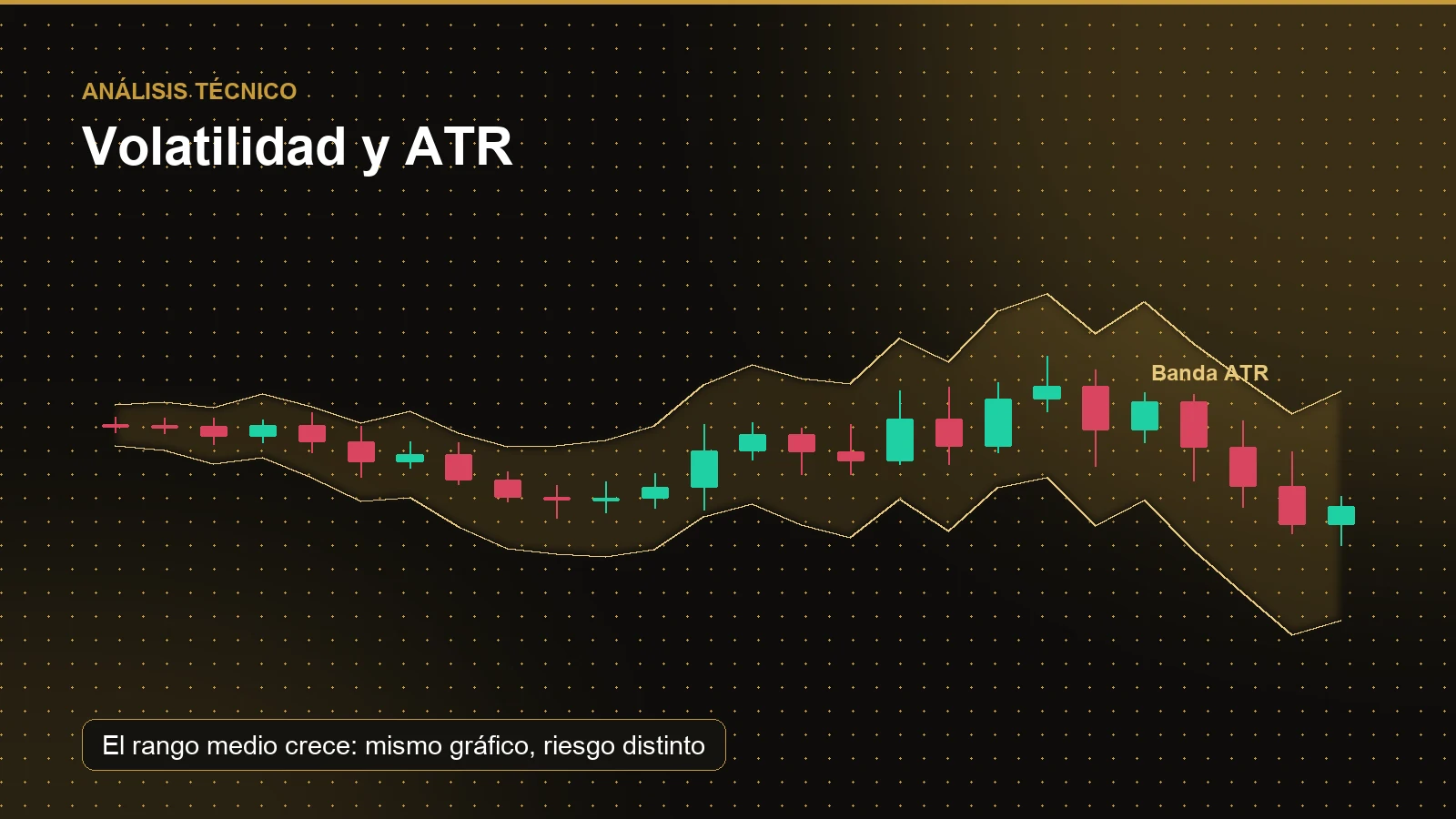
For day-to-day trading, the most practical tool is the ATR, the average true range. For each candle it takes the largest of three distances (the candle’s range, the distance from the high to the previous close and from the low to that same close) and averages the result, usually over 14 periods. By including the previous close, the ATR captures opening gaps and not just the visible range: it genuinely measures how much the asset moves in a typical session.
Its first application is the stop loss. Placing a stop a fixed number of pips away ignores the fact that the same instrument moves very differently in November than in August. Setting it at a multiple of the ATR (two times the ATR of the timeframe you trade, for example) puts the invalidation level outside the asset’s normal noise. A stop that is too tight does not reduce risk: it only raises the odds that noise will trigger it.
The second application is position size, and it is the more important one. If you decide in advance how much you are prepared to lose on a trade, size follows from dividing that amount by the stop distance multiplied by the pip value. The consequence is that when volatility rises, the stop moves further away and the position size must come down. That way risk per trade stays stable even when the market changes regime.
Volatility also has geography and a timetable. It is higher in the London–New York overlap than in the Asian session, and it differs greatly between assets: gold and the indices move in percentage ranges unlike those of a major pair, and exotic crosses combine wide ranges with pricier spreads. Synthetic indices, meanwhile, are designed with a stable volatility profile available 24 hours a day, which makes them a case of their own.
Finally, it helps to know what sets it off: macroeconomic releases and rate decisions, central bankers’ speeches, geopolitical surprises, quarter-ends with portfolio rebalancing, and thin-liquidity sessions around public holidays. None of these events is predictable in its outcome, but almost all of them are predictable in their date. In MetaTrader 5 the ATR is a standard indicator and can be added to a chart in seconds; what no indicator can do is remove the risk of loss.
The essentials
Size, not direction
Volatility tells you how far an asset moves, never which way.
Historical and implied
One looks at what happened; the other at what the market expects to happen.
The ATR measures the true range
It includes opening gaps, not just the candle’s visible range.
Volatility up, lot size down
A wider stop demands a smaller position to keep risk unchanged.


Redacción VexPro
VexPro is the broker of VEX GROUP, a global financial and technology group present in 7 jurisdictions, and serves clients in more than 160 countries. Product news, expansion, events and regulation from the group.